 Ever stood in front of a mirror, hair pulled back, tilting your head side to side trying to work out whether your face is “round” or “oval” or just… some shape you can’t name? If so, welcome. You’re in good company. Most of us go years without paying much attention to our own bone structure, right up until a hairstylist or makeup artist asks, almost offhand, “So, what’s your face shape?” And there you are, stumped.
Let me put your mind at ease first: there’s no wrong answer here. Every face shape has something going for it. Figuring out yours isn’t a test of whether you’re attractive enough. It’s just a tool, the same way knowing your shoe size makes buying shoes less of a gamble. Once you know what you’re working with, picking a haircut that suits you, choosing sunglasses that don’t fight your features, or trying a makeup trick that shows off your best angles all get a whole lot easier.
So that’s what we’ll do here. We’ll go through the main face shapes, show you a simple way to figure out yours, and then talk about some down-to-earth, no-pressure ways to make the most of what you’ve got.
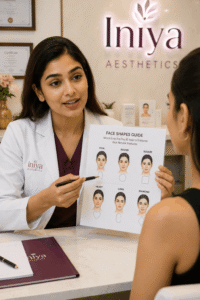
What Are the Different Types of Face Shapes?
Most faces fall into one of a handful of broad categories. Notice I said “broad.” Real faces almost never look like the tidy little diagrams in a textbook, and plenty of people are a mix of two. Still, these categories give you somewhere to start.
- Oval: This one gets called the most “balanced” shape, mostly because the edges are gently rounded, the jaw sits a touch narrower than the forehead, and the cheekbones are the widest part. Think proportionate, not “perfect.”
- Round: Here the cheeks are the widest point, the jaw and chin are soft and curved, and the length and width of the face are pretty close. Round faces tend to keep a youthful softness for years.
- Square: A strong, angular jaw, a broad forehead, and not much difference in width between the forehead, cheekbones, and jaw. Square faces read as striking and defined.
- Heart: A wider forehead that tapers down to a narrower, sometimes pointed chin. A lot of heart-shaped faces come with a subtle widow’s peak too.
- Oblong or rectangular: Picture a square, then stretch it a little. The forehead, cheeks, and jaw are roughly equal in width, but the face is noticeably longer than it is wide.
- Diamond: A narrower forehead and jaw with the cheekbones stealing the show as the widest, most prominent feature. High, sculpted cheekbones are the giveaway here.
And remember, faces are three-dimensional and full of tiny quirks, so don’t stress if yours refuses to sit neatly in one box.
How to Identify Your Face Shape
Good news: you don’t need anything fancy. A mirror, a soft measuring tape (or a bit of string you can measure afterwards), and about five minutes will do it.
- First, measure your forehead: Go across the widest part, usually from one side of your hairline to the other, roughly at eyebrow level.
- Next, your cheekbones: Run the tape from the outer corner of one eye across to the outer corner of the other, following the top of your cheekbones.
- Then your jawline: Measure from one corner of your jaw to the other, just below the ears.
- Finally, the length of your face: Go from the center of your hairline straight down to the tip of your chin.
Now you’ve got four numbers to compare. A few rough guides: if your face is clearly longer than it is wide and your jaw is soft and rounded, you probably lean oval. If the length and width are close and the jaw is rounded, round is more likely. If your forehead, cheeks, and jaw come out about the same with sharper angles, that points to square. If your forehead is the biggest number and your chin is narrow, think heart. If your face is much longer than it is wide, oblong. And if your cheekbones are the clear winner, you’re likely a diamond.
Here’s another trick that honestly tells you more than any tape measure. Pull your hair back, look dead-on into the mirror, and trace the outline of your face on the glass with a dry-erase marker. (No marker? Just study the shape you see.) That overall outline usually gives the game away faster than fussing over individual numbers.
Which Face Shape Is the Most Attractive?
Let’s be real, this is probably the question that pulled you in. Is there actually a “most attractive” face shape, a best one, a single perfect face shape?
Short answer: no. Not in any scientific or agreed-upon way. When people type “which face shape is more attractive” into a search bar, they’re usually after a neat ranking. But the research keeps landing somewhere more interesting. Attractiveness has far less to do with which box your face fits into and far more to do with symmetry, balance, and how your own features work together.
An oval face isn’t secretly superior to a square or a heart. It just gets used as a reference point in beauty and hair guides because it happens to be easy to style, so fewer tweaks are needed. Easy to work with, sure. Better, no. Meanwhile strong square jaws, delicate heart-shaped faces, and sky-high diamond cheekbones have all had their moment in the spotlight across different eras, cultures, and personal tastes.
So if you’re hunting for the perfect face shape, the kind people keep asking about, here’s the truest answer I can give you: it’s the one you’ve already got, styled in a way that plays up what’s there.
How to Enhance Your Natural Features Based on Your Face Shape
Instead of trying to “fix” anything, think of this as learning to play to your strengths.
Hairstyles
Round faces often love a bit of height at the crown and layers that add length, like a long layered cut or a side-swept fringe. Square faces soften up nicely with waves, a side part, or textured layers around the jaw. Heart-shaped faces tend to suit chin-length bobs or anything with a bit of volume near the jaw to balance out a narrower chin. Oblong faces do well with waves or curls that add width, plus a fringe to visually shorten things. Diamond faces pair beautifully with side-swept bangs or styles that add fullness at the forehead and chin.
Makeup techniques
Contouring and highlighting sound intimidating, but they really just come down to guiding the eye where you want it and quietly blending what you don’t. A light contour along the jaw can take the edge off a strong angle, and a dab of highlighter on the cheekbones brings dimension to a rounder face.
Eyebrow shapes
People underestimate brows. They genuinely change how a whole face reads. Softer, rounded brows can calm down angular features, while a bit of arch adds structure to a rounder face.
Accessories
Even your sunglasses or earrings get in on the game. Angular frames add definition to soft, round faces, and rounded frames help mellow a stronger jaw.
Skincare
Confidence tends to start with skin that feels healthy. A steady routine, cleansing, hydration, and sun protection, supports your skin’s natural texture and glow no matter your face shape.
Non-surgical aesthetic treatments
And for anyone curious to go a step further, there are non-invasive options meant to support skin firmness, tone, or contour. These are entirely optional, a personal choice, and never a box you have to tick to look your best.
Can Aesthetic Treatments Enhance Facial Features?
Some people are perfectly happy tweaking a hairstyle or switching up their makeup and leaving it there. Others get curious about professional treatments that support skin health or gently refine facial contours over time. Both are completely valid. It comes down to your own goals and what you’re comfortable with, nothing more.
If you do want to look into it, a good first step is a conversation with a qualified aesthetic clinic in Kolkata who can actually assess your facial structure, skin condition, and what you’re hoping for before suggesting anything. Suitability really does differ from one person to the next, which is why a proper consultation matters far more than any one-size-fits-all recommendation you’ll read online.
As an example, some people look into HIFU treatment in Kolkata, a non-invasive option that uses focused ultrasound energy to support skin firmness and a more lifted look over time. Others are more focused on tone and radiance and explore things like skin whitening treatment, which some clinics offer as part of a wider skin-brightening approach.
One honest note worth holding onto: no treatment can, or should claim to, rewrite your underlying bone structure. Any clinic worth its salt will be upfront about realistic results rather than dangling dramatic before-and-after promises.
A Few Final Thoughts
At the end of the day, face shape guides are meant to help, not box you in. They’re a jumping-off point for choosing hairstyles and makeup that feel like you, not a rulebook you’re obliged to follow line by line. Honestly, some of the most memorable looks come from people who threw the “rules” out entirely.
So the next time someone asks what your face shape is, you’ll have an answer ready, and hopefully a little more fondness for the features that make your face yours and nobody else’s.