
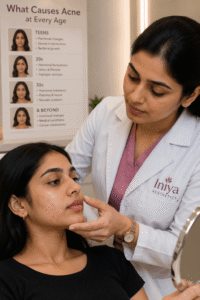
 Thought pimples were something you left behind with school exams and awkward growth spurts? Plenty of people did, right up until acne showed up again in their late 20s. Or their 30s. Acne has this reputation as a teenage problem. It isn’t. People break out at pretty much every stage of life, and what causes acne looks different depending on where you are.
That’s the whole point of this article, really. The pimple age isn’t stuck to one decade. Whatever triggers a breakout at 16 is often nothing like what’s causing it at 28, or 34. Hormones, genetics, oil production, stress, the products sitting in your bathroom cabinet, your daily habits, sometimes an underlying health issue, all of it can play a part, and the mix keeps shifting as you get older. Knowing what’s actually behind your acne matters, because it decides what kind of acne treatment stands a chance of helping.
In this guide: how acne forms · teenage acne · acne in your 20s · acne in your 30s · acne beyond 30 · hormonal acne · stress and pimples · habits that worsen acne · when to see a skin specialist · professional treatment options · FAQs
What Causes Acne? How a Pimple Actually Forms
Before getting into the age-by-age stuff, here’s the basic mechanics of how a pimple actually forms.
Skin makes oil (sebum) to stay moisturised, and sheds dead cells on a regular cycle. Acne shows up when those two processes fall out of step. Excess oil mixes with dead skin, clogs the pore, and bacteria already living on your skin multiply inside that clog. That triggers inflammation. Redness, swelling, a pimple, that’s the whole chain.
So the four causes of acne, in order:
- Excess oil (sebum) production
- Clogged pores from oil mixing with dead skin cells
- Bacteria multiplying inside the blocked pore
- Inflammation, which is the redness and swelling you actually see
Hormones usually sit behind a lot of this, since they directly control how much oil your glands pump out. Line up enough of these factors and a breakout tends to follow. How bad it gets varies wildly from one person to the next.
What Causes Acne During the Teenage Years
Teenage acne is the version everyone recognises, and it tracks straight back to puberty. Hormones shift, oil glands go into overdrive, and pores clog more easily than they used to. Family history plays a role too; acne genuinely does run in families.
Common causes of acne in teenagers:
- Puberty hormones driving up oil production
- Genetics and family history of acne
- Pores clogging more easily as skin changes
- Higher oil-gland activity across the face, chest and back
Add in the general skin changes that come with growing up and you’ve got the classic teenage combination, usually landing on the face, forehead, nose, cheeks, and sometimes the chest and back, since oil glands there tend to be more active at this age.
What Causes Acne in Your 20s
A lot of people assume acne will simply be over once the teenage years end. For plenty, it isn’t. It either sticks around or, annoyingly, turns up for the very first time in your 20s.
What’s usually behind adult acne at this stage:
- Ongoing hormonal swings, especially tied to the menstrual cycle
- Stress, from work, study, or whatever life transition you’re mid-way through
- Irregular sleep or eating patterns
- Skincare or makeup that doesn’t actually suit your skin type
- Straight-up poor sleep
- Diet, for some people
- Oil production that just hasn’t settled down yet
The acne trigger at 24 can be nothing like the trigger at 17, which is exactly why the same product that cleared your skin as a teenager might do nothing now. This is usually the point where people start actually investigating the cause instead of just slapping something on the surface symptom.
What Causes Acne in Your 30s
By your 30s, most people expect this chapter to be closed. So it stings a bit when it isn’t. Adult acne here is genuinely common, and it tends to trace back to a slightly different mix:
- Ongoing hormonal fluctuation
- Accumulated stress from work and family life
- Menstrual-cycle changes
- Pregnancy-related hormonal shifts
- Certain medications
- Skincare that no longer suits your changing skin
- Broader lifestyle factors like poor sleep
If acne shows up suddenly in your 30s, or refuses to quit, that’s usually worth a proper professional look rather than assuming it’ll sort itself out.
What Causes Acne Beyond Your 30s
Acne doesn’t stop at 30 either. Some people keep breaking out, or start noticing new spots, well into their 40s and beyond. The usual drivers:
- Ongoing hormonal change and perimenopause
- Certain medications
- Stress that’s piled up over the years
- Skincare that’s too harsh for maturing skin
- An underlying health factor a professional needs to actually assess
Persistent or unusual breakouts at this stage deserve a real consultation, not a guess based on symptoms alone.
Hormonal Acne at Different Ages
Notice how hormones keep showing up behind acne at every single stage above? Not a coincidence. Puberty, the regular menstrual cycle, pregnancy, the post-pregnancy rebalancing period, perimenopause, all of these can trigger hormonal acne. But timing alone doesn’t prove hormones are the cause. Genuine hormonal acne needs an actual assessment, not an assumption just because it lined up with one of these stages.
Can Stress Cause Pimples?
Short answer: probably, at least indirectly, though it rarely explains a breakout on its own. Stress can mess with hormone activity in ways that ramp up oil production. It wrecks sleep, and bad sleep shows up on your skin. It nudges you toward touching your face more, or skipping your skincare routine entirely some nights. It can even make existing inflammation worse. None of that makes stress the cause of any one acne breakout, it’s one ingredient in a longer list.
Common Habits That Make Acne Worse
Beyond the bigger causes, small daily habits quietly make acne worse:
- Picking or squeezing, which almost always worsens inflammation and raises your scarring risk
- Skincare that doesn’t match your skin type
- Over-washing, which strips natural oils and can trigger even more oil production as a rebound
- Sleeping in your makeup
- Comedogenic products that clog pores more easily
- Touching your face constantly through the day
- Chasing online trends instead of professional advice
Fix even a couple of these and you’ll often see your acne calm down, before any professional treatment even enters the picture.
When Should You See a Skin Specialist for Acne?
Occasional breakouts are normal at almost any age, but there are moments when it makes sense to get proper professional input rather than continuing to manage things on your own. Consider consulting a skin specialist if:
- It’s persistent and just won’t improve
- Breakouts are painful, deep, or unusually large
- You’re left with acne scars or dark marks
- You suddenly start breaking out as an adult after years of clear skin
- Over-the-counter acne products aren’t touching it
- It’s affecting your confidence or daily life
A professional evaluation gets to what’s actually triggering your specific breakouts, and points you toward a plan built for your skin, not a generic one off a shelf.
Professional Treatments for Acne and Post-Acne Concerns
Acne treatment depends entirely on the type and severity of the acne, plus your individual skin. There’s no universal fix here.
1. Chemical Peels
Depending on professional evaluation, a chemical peel in Kolkata may be considered for certain acne-related concerns, since peels work by encouraging fresher skin to surface and can help with some types of texture or tone irregularities.
2. Hydrafacial
For people focused more on general skin maintenance and cleansing, a hydrafacial in Kolkata may be worth discussing with a specialist, though its suitability depends on individual skin needs and concerns.
3. Skin Lightening Treatment
Post-acne marks and pigmentation are a common concern once active breakouts settle down. Some people explore a professional skin lightening treatment for uneven tone left behind by old acne, though this should always be chosen based on the specific concern and a proper assessment rather than assumed to work the same way for everyone.
None of these cure acne outright. They handle specific concerns, and work best as part of a bigger plan a professional actually guides.
How Acne Treatment Changes With Age
A 16-year-old with hormonal breakouts and a 32-year-old dealing with stress-related or post-pregnancy acne need completely different approaches. What shapes the right path forward:
- Age and life stage
- Skin type
- The specific kind of acne
- Relevant hormonal factors
- How severe it is
- Whether scarring or pigmentation is involved
- Whatever you’ve already tried
Which is exactly why the acne routine that worked wonders for your sister or your best friend might do nothing for you. A personalised assessment beats generic advice almost every time, and that gap only widens as your skin changes with age.