
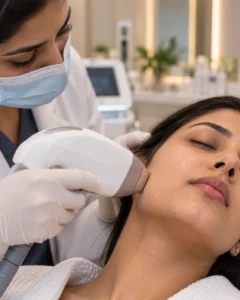
 At some point, usually after one too many ingrown hairs or a wax appointment gone wrong, most people start typing “electrolysis vs laser hair removal” into a search bar and hoping for a clean answer. Both get marketed as permanent. Both mean sitting through appointments spaced weeks apart. And both cost enough that you’d rather not guess wrong and pay twice.
Quick spoiler: they’re not really competing for the same job. One is permanent in the strict, clinical sense of the word. The other is a very good long-term reduction that most people are perfectly happy calling “permanent enough.” Which one actually wins depends on your hair, your skin, and how much time you’re willing to spend in a treatment chair.
What Is the Difference Between Laser Hair Removal and Electrolysis?
Laser hair removal works by targeting melanin (the pigment in your hair) with concentrated light. That light turns to heat inside the follicle and disables its ability to keep producing hair. Because it treats a whole area at once, laser can cover legs, arms, or a back in a single sitting.
Electrolysis does something completely different. A fine probe goes into each individual follicle, one at a time, and a small electrical current destroys the cells responsible for growing hair there. No pigment involved at all, which is exactly why electrolysis works on hair colors laser simply can’t touch: light, grey, even white hair.
How Does Laser Hair Removal Compare With Electrolysis?
Speed is laser’s obvious win. A full session on a treatment area takes minutes. Electrolysis, by comparison, is slow going, one follicle at a time, which is why it’s usually reserved for smaller, more precise areas like the chin, upper lip, or eyebrows rather than a whole leg.
Permanence flips the script, though. The FDA recognizes electrolysis as the only hair removal method that qualifies as genuinely, permanently permanent. Laser is more accurately described as long-term reduction: most people see 85 to 90 percent less hair after a full course, but some regrowth (often finer, lighter) tends to creep back over the following years and occasionally needs a touch-up.
Cost and comfort differ too. Individual electrolysis sessions are cheaper, but they stack up fast across the number of visits a full area needs. The sensation is often compared to repeated tweezing, not painful exactly, just tedious. Laser, especially on modern systems, is far quicker per session and close to pain-free, usually described as a light snap against the skin.
How Do Laser Hair Removal and Electrolysis Work?
Both methods are trying to damage the structures inside a follicle enough that it stops producing hair. They just get there very differently. Laser devices are tuned to wavelengths absorbed specifically by melanin, so the light passes through skin, gets soaked up by pigment in the hair shaft, and converts to heat right where it’s needed. That’s also the historical catch: older laser systems worked best on dark hair with light skin. Newer platforms, including devices calibrated for Indian skin tones, have closed a lot of that gap and made laser far safer and more effective across a broader range of skin types.
Electrolysis skips pigment entirely and goes straight for the follicle base with current. Skin tone, hair color, none of it matters much here, which is exactly why it’s the fallback option for hair that simply refuses to respond to laser.
Is Electrolysis or Laser Hair Removal Better for PCOS?
This is probably the real reason a lot of people land on this comparison in the first place. PCOS-driven hirsutism tends to produce hair that’s finer, lighter, and more stubborn than typical body hair, partly because the underlying hormonal activity keeps recruiting new follicles even after existing ones have been treated.
For finer, lighter PCOS-related hair on the chin, upper lip, or jawline, electrolysis usually performs more reliably simply because it isn’t relying on pigment to work. Laser still has a place for coarser, darker growth on larger areas like the abdomen or back, where treating each follicle individually just isn’t practical. In practice, a lot of people managing PCOS hirsutism end up combining both, laser for the bigger, darker-haired zones and electrolysis for the stubborn fine hairs on the face, alongside whatever hormonal management their doctor has them on.
Also Read: Why Dark Spots Are More Common in Indian Skin Types
How Do You Choose Between Electrolysis and Laser Hair Removal?
A few practical questions settle this faster than another ten comparison blogs ever will.
What color is the hair? Dark and coarse tends to respond well to laser. Light, grey, or fine usually needs electrolysis instead. How big is the area? Larger zones like legs or the back favor laser purely for practicality. Small, precise spots like eyebrows or the chin favor electrolysis. How much time do you actually have? Laser needs fewer, quicker visits. Electrolysis asks for more frequent, shorter ones stretched over a longer window. And is there a hormonal condition like PCOS driving the growth? If so, plan for a longer-term approach, possibly a mix of both, rather than expecting either method to be a one-time fix.
At Iniya Aesthetics, consultations start with an honest look at hair type, skin tone, and the specific areas you want treated before anything gets recommended. For most clients that means laser hair removal using technology suited to Indian skin and hair, typically landing in that 85 to 90 percent reduction range after 6 to 8 sessions. For finer facial hair that doesn’t respond well to laser, including candidates for laser facial hair removal who need something more targeted, electrolysis or a blended plan gets discussed case by case.