
 You notice it first in small, oddly specific ways. The ponytail feels thinner than it did last year. Your parting looks wider in photos. There’s a nest of hair in the shower drain that wasn’t there a few months ago, and every time you look at it you do a quick mental scan of what’s changed: stress, diet, the new shampoo, the heat. Often the answer isn’t any of those. It’s hormones.
Two of the most common hormonal reasons behind hair fall in women are PCOS and thyroid problems, and the encouraging part is that both are very treatable once you know they’re the culprit, which is why this guide walks through how each one affects your hair, which tests are worth asking for, and what actually helps.
How Does PCOS Cause Hair Thinning in Women?
PCOS, or polycystic ovary syndrome, often comes with higher levels of androgens, the “male” hormones that every woman produces in small amounts. In hair follicles that are sensitive to them, androgens shorten the growth phase and gradually shrink the follicle, so each new strand comes in finer and shorter than the last. That’s the basic mechanism behind PCOS hair loss.
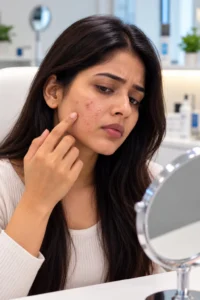
The pattern is usually recognizable. The parting widens, the crown thins, and the hairline at the front tends to stay put, unlike the receding hairline many men get. PCOS hair thinning often shows up alongside other signs: irregular periods, acne along the jawline, extra hair on the chin or upper lip, and weight changes. When several of these appear together, it’s worth getting checked instead of treating each one separately.
How Does a Thyroid Imbalance Trigger Hair Fall?
Your thyroid sets the pace for a lot of what the body does, including how hair follicles cycle through growth and rest, so when it’s underactive or overactive, more hairs than usual get pushed into the resting phase and then shed together a couple of months later. The result is thyroid hair loss that looks different from the PCOS pattern: diffuse thinning all over the scalp, not a widening part.
Other clues come with it. An underactive thyroid can make hair dry, coarse and brittle, and thin the outer part of the eyebrows. An overactive one tends to make hair fine and soft. Fatigue, weight changes, feeling unusually cold or hot, and mood shifts often travel with these changes.
There’s one detail that surprises people. The shedding usually starts two to three months after the thyroid imbalance began, so by the time the hair falls, the real trigger is already in the past. It also means regrowth is slow. Even after the thyroid is well controlled, hair often takes several months to come back.
Also Read: Postpartum Hair Loss: Causes and Solutions Every New Mom Should Know
Which Blood Tests Should You Get for Hormonal Hair Loss?
Hormonal hair loss is hard to pin down by looking at your scalp alone, which is why bloodwork matters. Your doctor will pick what’s relevant, but a typical list includes:
- Thyroid tests: TSH and free T4, sometimes free T3 or thyroid antibodies.
- Iron stores: ferritin and hemoglobin. Low ferritin is one of the most common and most overlooked reasons for hair fall in women, even when hemoglobin looks normal.
- Vitamin D and vitamin B12: both are frequently low and both are linked to hair health.
- Blood sugar markers: fasting glucose, fasting insulin or HbA1c, since insulin resistance often goes hand in hand with PCOS.
- Androgen and hormone panel: total and free testosterone, DHEA-S, LH and FSH, prolactin, and sometimes SHBG.
It also helps to go in with a short note of when the shedding started, any recent illness, crash dieting, or big stress, and your menstrual pattern. That timeline helps your doctor decide which tests to prioritize.
Can PRP or GFC Help With Hormonal Hair Loss?
They can help, with one important condition: they work best as support alongside treating the hormonal cause, not instead of it, because if PCOS or a thyroid imbalance stays uncontrolled, even the best scalp treatment is swimming against the current.
PRP, or platelet-rich plasma, uses a concentrate made from your own blood and injects it into the scalp to stimulate follicles. It’s been studied for pattern hair thinning and tends to give better results when it’s started early, while the follicles are still active. If you’d like the detail, here’s how PRP in Kolkata works at Iniya. GFC treatment in Kolkata takes a similar idea one step further, using a purified concentrate of growth factors. Both are usually done as a series of sessions spaced about a month apart, followed by occasional maintenance.
Medical treatment fits alongside these. Topical minoxidil is the best-established option for female pattern hair loss, and for PCOS-related thinning, doctors sometimes prescribe anti-androgen medicines or hormonal therapy. Those need a proper prescription and aren’t suitable during pregnancy, which is one more reason not to self-medicate.
Which Lifestyle Changes Support Hair Regrowth?
No habit will reverse hormonal hair loss alone, but the right ones give your treatment a better chance.
- Fix the deficiencies. If your ferritin, vitamin D or B12 is low, correcting it matters as much as any scalp treatment.
- Eat enough protein. Hair is made of it, and diets that quietly cut protein are a common cause of extra shedding.
- Avoid crash dieting. Rapid weight loss can trigger shedding of its own, months later.
- Work on insulin resistance if you have PCOS: regular movement, steady meals, and cutting back on sugary drinks help both the hormones and the hair.
- Protect your sleep and manage stress. Both affect the hair cycle more than most people expect.
- Go easy on the scalp. Skip tight hairstyles and cut down on heat styling while hair is fragile.
Patience is the hardest part. Shedding often slows within two to three months of starting the right treatment, and visible regrowth usually takes six to twelve months. If hair fall has been going on for more than a few months, don’t wait it out. A dermatologist in Kolkata can sort out whether it’s PCOS, thyroid, iron or a mix, and build a plan around it.