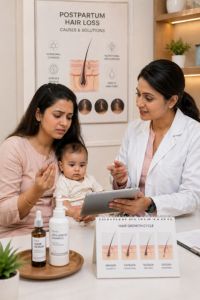
You just had a baby, and now handfuls of hair are coming out every time you shower or brush. It feels alarming, and it can knock your confidence at a time when you are already running on little sleep. But here is the truth: postpartum hair loss is extremely common, and for most women, it is completely temporary.
This guide walks you through everything you need to know about post pregnancy hair loss, why it happens, when it stops, and what you can actually do about it.
What Is Postpartum Hair Loss and Is It Normal?
Yes, it is absolutely normal. Postpartum hair loss, also called postpartum telogen effluvium, is a phase of excessive hair shedding that many women experience after giving birth. Studies suggest that nearly 40 to 50 percent of new mothers notice significant hair loss in the months following delivery.
The good news? It is not true hair loss in the medical sense. You are not going bald. What is actually happening is your hair catching up after a pause it took during pregnancy. Your overall hair volume will return, even though the process can feel scary while it is happening.
Why Does Postpartum Hair Loss Happen After Delivery?
It comes down to hormones, specifically estrogen. Hair does not grow in a straight line. It moves through a cycle with three main phases:
- Anagen (growth phase) – This is the active stage where hair is actually growing from the follicle
- Catagen (transition phase) – Growth begins to slow and the follicle starts to pull back
- Telogen (resting phase) – The hair sits, rests, and eventually falls out to make room for new growth
Under normal circumstances, different hairs are at different stages of this cycle at any given time, which is why we shed a little each day without going noticeably thin.
During pregnancy, though, high estrogen levels essentially pause this process. A much larger proportion of your hair stays in the growth phase and does not shed the way it normally would. That is the reason your hair feels so thick when you are pregnant.
After delivery, estrogen levels fall quickly and sharply. The body takes stock and realises a lot of hair has been sitting in the growth phase far longer than usual. All of it starts transitioning toward the shedding phase around the same time. The result is the sudden, heavy postpartum hair loss that so many new mothers experience a few months after giving birth.
On top of the hormonal shift, a few other things can make the shedding worse:
- Low iron or nutritional gaps from the demands of pregnancy and breastfeeding
- High physical and emotional stress during labour and the newborn phase
- Thyroid changes, which are actually quite common after delivery and often go undiagnosed
- Broken sleep and general physical exhaustion
When Does Postpartum Hair Loss Start and Stop?
For most women, the shedding becomes noticeable somewhere around 2 to 4 months after delivery. It tends to feel most intense around the 3 to 4 month mark, which is also when a lot of new mothers start to get worried about it.
When does postpartum hair loss stop?
This is the question most people really want answered. Generally, the heavy shedding begins to ease off by around 6 months postpartum. Hair usually gets back to its pre-pregnancy thickness somewhere between 9 and 12 months after delivery, though for some women it takes closer to 18 months.
The timeline can vary depending on your nutrition, stress levels, whether you are breastfeeding, and whether there are any underlying health issues at play.
If your hair loss is still heavy past the 12-month mark or feels disproportionate to what others describe, it is worth getting checked out. Thyroid dysfunction and iron deficiency anaemia are two of the more common culprits behind prolonged post pregnancy hair loss, and both are very treatable once identified.
What Are the Best Solutions for Postpartum Hair Loss?
There is no single magic fix here, but that does not mean you are helpless. A combination of good nutrition, gentle habits, and the right support can make a meaningful difference in how much you shed and how quickly your hair recovers.
Nutrition First
Hair is made of protein, and its growth depends heavily on the nutrients your body has available. When you are breastfeeding or simply running on not enough sleep and not enough food, your body prioritises survival over hair growth. Eating well is genuinely one of the most effective postpartum hair loss remedies available to you.
Focus on getting more of these into your daily meals:
- Iron from leafy greens, lentils, red meat, and fortified cereals
- Protein from eggs, fish, chicken, dairy, and legumes
- Omega-3 fats from walnuts, flaxseeds, chia seeds, and oily fish
- Vitamin C alongside iron-rich foods to help your body absorb the iron better
- Biotin from eggs, almonds, sunflower seeds, and sweet potatoes
Supplements for Postpartum Hair Loss
Diet is the foundation, but let us be real. Many new mothers are not managing perfectly balanced meals in the early months, and that is completely understandable. This is where the right supplements for postpartum hair loss can genuinely help fill the gaps.
Some worth discussing with your doctor:
- Iron – only supplement if a blood test confirms you are deficient
- Biotin – supports keratin production and is generally safe while breastfeeding
- Vitamin D – particularly important if you spend most of your time indoors
- Zinc – plays a key role in keeping hair follicles healthy and functioning
- Collagen peptides – help with overall hair strength and texture
- Postnatal multivitamins – a convenient way to cover multiple bases at once
Please check with your doctor or a nutritionist before adding anything new, especially while you are breastfeeding.
Small Hair Care Changes That Add Up
While shedding driven by hormones is not fully preventable, there is a category of hair loss that you can control, and that is the mechanical kind. Being rough with your hair when it is already fragile makes things noticeably worse.
A few simple adjustments:
- Swap your regular comb for a wide-tooth one and always start detangling from the ends, not the roots
- Give tight hairstyles a break for a while, high ponytails and buns pull on already weakened hair
- Move to a sulphate-free shampoo that is gentler on the scalp
- Cut back on heat styling as much as you can
- Try sleeping on a silk or satin pillowcase to reduce overnight friction
How Can You Prevent or Minimize Postpartum Hair Loss?
While you cannot stop postpartum hair loss entirely since it is driven by hormones, you can take steps to reduce its severity.
- Start a postnatal vitamin routine before or right after delivery
- Stay hydrated since dehydration affects hair health
- Manage stress through light exercise, meditation, or even a short daily walk
- Scalp massage for 5 minutes a day boosts blood circulation to the hair follicles and encourages regrowth
- Get your thyroid and iron levels checked if shedding seems excessive or prolonged
- Eat enough calories, especially if breastfeeding, as caloric restriction worsens hair loss
Which Treatments Actually Work for Postpartum Hair Regrowth?
Once shedding has slowed, your focus can shift to supporting regrowth. Here is what has evidence behind it.
Topical Minoxidil
Minoxidil (commonly known as Rogaine) is one of the few clinically proven treatments for hair loss. It stimulates follicles and extends the growth phase. However, it is not recommended while breastfeeding, so discuss timing with your doctor.
PRP Treatment (Platelet-Rich Plasma)
PRP therapy involves drawing a small amount of your blood, processing it to concentrate growth factors, and injecting it into the scalp. It has shown promising results for stimulating dormant follicles. If you are looking for the best hair treatment in Kolkata for post pregnancy hair loss, many advanced clinics now offer PRP treatment in kolkata with certified dermatologists.
Low-Level Laser Therapy (LLLT)
Laser hair caps and devices that use low-level laser therapy are an at-home option that can stimulate hair growth with regular use. Results typically appear after 3 to 6 months of consistent use.
Professional Scalp Treatments
A dermatologist or trichologist can evaluate your specific hair and scalp condition and recommend targeted treatments, from medicated serums to in-clinic procedures. If you are in the Kolkata region and looking for the best hair treatment in Kolkata, seek out a board-certified dermatologist who specialises in hair restoration for personalised care.
Also Read: Best Hair-fall Treatment in Kolkata
Postpartum Hair Loss Is Temporary: Here Is What to Do Next
Postpartum hair loss is common, hormonal, and most importantly, temporary. Feed your body well, treat your hair gently, and be patient with yourself. Your body has done something truly extraordinary.
That said, every woman’s experience is different, and sometimes you need a little expert guidance to get back on track. At Iniya Aesthetics and Wellness in Kolkata, our caring team of dermatologists and hair specialists offer personalised consultations and advanced treatments for post pregnancy hair loss, from PRP therapy to targeted scalp care.
You do not have to navigate this alone. Book a consultation with Iniya Aesthetics and Wellness today and take the first step toward feeling like yourself again.