
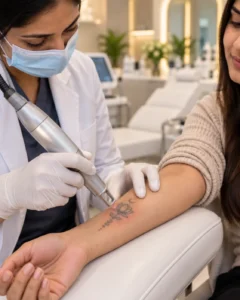
 There’s a very specific kind of regret that arrives with a tattoo that felt perfect at twenty-two and feels like a mistake at thirty-two. And once you’ve made peace with wanting it gone, the next question is almost always the same: how many sessions is this going to take? Fair question. Most people would like a number before they commit months and a fair bit of money to the process.
It’s not a one-visit fix for nearly anyone, tattoo removal. But once you understand what’s actually driving the session count, the whole thing stops feeling like an open-ended commitment and starts feeling like something you can actually plan around.
What Is Tattoo Removal and How Does It Work?
Modern tattoo removal runs on laser technology, not the older, rougher methods like dermabrasion or surgical excision that used to be the go-to. The laser fires focused pulses of light energy that travel through the skin and hit the ink directly, shattering those particles into much smaller fragments.
And this is the part that explains why it takes time rather than happening in one go: once the ink is broken down, it’s your own immune system (cells whose job is clearing away debris) that slowly carries those fragments off over the following weeks. The laser doesn’t erase the tattoo on the spot. It just breaks the ink small enough for your body to finish the job, and that’s a biological process. No amount of turning up the laser settings speeds it along.
How Many Sessions Does Tattoo Removal Usually Take?
Most tattoos land somewhere between six and twelve sessions, spaced four to six weeks apart so the skin and immune system get time to recover and clear ink in between. Do the math and a full course usually stretches across six months to a year, longer for bigger or more complicated pieces.
A handful of factors push that number up or down:
Ink color matters more than people expect. Black absorbs laser wavelengths efficiently and clears fastest. Colored inks (red, green, yellow, light blue especially) are stubborn and often need more sessions, sometimes with different wavelengths for different colors. Depth and density matter too: professionally applied tattoos tend to sit deeper and denser than amateur or homemade ones, which usually makes them slower to shift despite looking more “solid.” Size is the obvious one: bigger tattoos take longer, both because there’s more area to cover and because larger pieces sometimes get split up to manage healing load. Skin tone plays a role as well, since darker skin needs more careful laser calibration to avoid pigment changes, which can mean a slower, more conservative pace. And the age of the tattoo counts for something too: older ink has often already faded and broken down a little on its own, which can shave sessions off compared to a fresh, heavily saturated one.
Can a Permanent Tattoo Be Completely Removed?
Mostly, yes. But not always down to zero trace, and it’s worth knowing that going in. Black ink on lighter skin usually has the best odds of near-total removal. Tattoos with multiple colors, heavy shading, or ink pushed very deep sometimes leave a faint shadow behind even after a full course of sessions.
That’s not the treatment failing. It’s just a real limit of the technology. If total, invisible removal genuinely matters to you (say, you’re clearing the way for a cover-up), bring that up explicitly during your first consultation. Better to set expectations at session one than be disappointed at session ten.
What Are the Side Effects of Tattoo Removal?
Done by someone trained, with proper technique and aftercare, tattoo removal is generally safe, but it’s not without side effects. Expect some redness, swelling, and mild blistering for a few days after each session; that’s just the skin’s normal healing response. Temporary color changes, lighter or darker than the surrounding skin, can happen too and usually settle down over time.
The rarer, more serious risks, scarring and permanent pigment changes, are uncommon but not impossible, and they’re closely tied to how well you follow aftercare. Picking at blisters, skipping sunscreen on the treated area, letting fresh skin take friction or heat before it’s healed: all of that raises the odds noticeably. Your provider’s aftercare instructions matter almost as much as the laser itself.
How Can You Support Faster, Safer Healing Between Sessions?
The real work happens between appointments, not during them, so how you treat the skin afterward genuinely affects both how you heal and how well you respond to the next round.
Keep the treated area covered and out of the sun for the whole healing window, since UV exposure on freshly lasered skin raises the risk of pigment changes. Skip soaking it: pools, baths, long showers, all of it, until any blistering or scabbing has properly closed up. Don’t pick at scabs or blisters, full stop. That’s one of the most preventable causes of scarring after this kind of treatment. Once the initial healing phase passes, keep the area moisturized with something gentle and fragrance-free. And hold off on workouts heavy enough to make you sweat over the area for the first few days, since sweat and friction irritate healing skin more than people expect.
None of this is complicated. It just has to actually happen, every time, between every session, not only when you remember.
Also Read: Carbon Laser Facial: Benefits and Who Should Try It
When Can You Expect to See Results From Tattoo Removal?
Fading builds gradually. It’s not dramatic after one visit, and it shouldn’t be. Most people notice real lightening after two to three sessions, with the tattoo continuing to fade as more sessions go by and the body clears more ink each time. Judging results after session one, or expecting the tattoo gone by session three, is probably the single biggest source of frustration people run into during this process.
At Iniya Aesthetics, tattoo removal sessions typically run 10 to 30 minutes depending on the tattoo’s size, spaced four to six weeks apart, with most tattoos needing six to twelve sessions in total. Sun avoidance and proper aftercare between sessions aren’t optional here, since irritated or sun-exposed skin simply doesn’t respond as predictably to the next round of treatment. For anyone left with uneven skin tone in the area once the tattoo has faded, options like skin whitening treatment sometimes come up as a way to even out the final result.